Warehouse automation background
Large warehouses use robots for sorting, transport, and picking. Public Amazon Robotics information shows that robotic systems typically combine perception, vehicle control, scheduling, and site-safety mechanisms. For an unmanned forklift, stable pallet and pose recognition is a key input.Engineering challenges in pallet recognition
An unmanned forklift needs the pallet pose relative to the vehicle to adjust its docking path. In practice, lateral offset, heading, structure, and surface reflectivity vary. Ambient light and occlusion can also affect sensor data quality.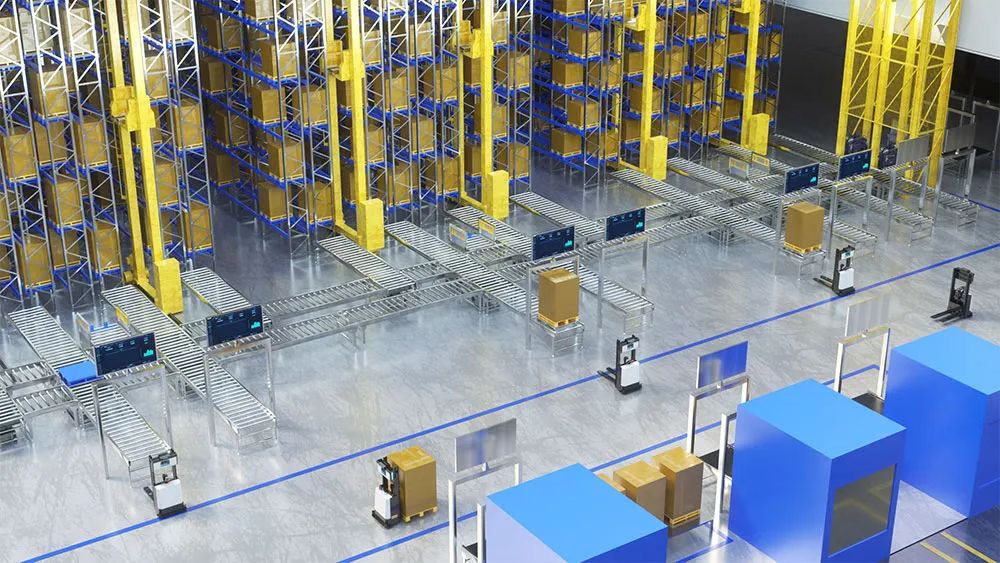
Recognition approach
PalletPro extracts point-cloud features such as pallet legs and crossbars from 3D ToF depth data, then outputs the pose used by the vehicle for docking. Labels and 2D LiDAR can work in specific environments, but suitability depends on the pallet structure, installation, and site conditions.PalletPro pallet-recognition system
PalletPro combines a 3D camera with pallet-recognition algorithms and supplies pallet position and orientation to the vehicle control system.- Integrated processing and output: The algorithm processes depth data on the camera and outputs recognition results at 10 FPS.
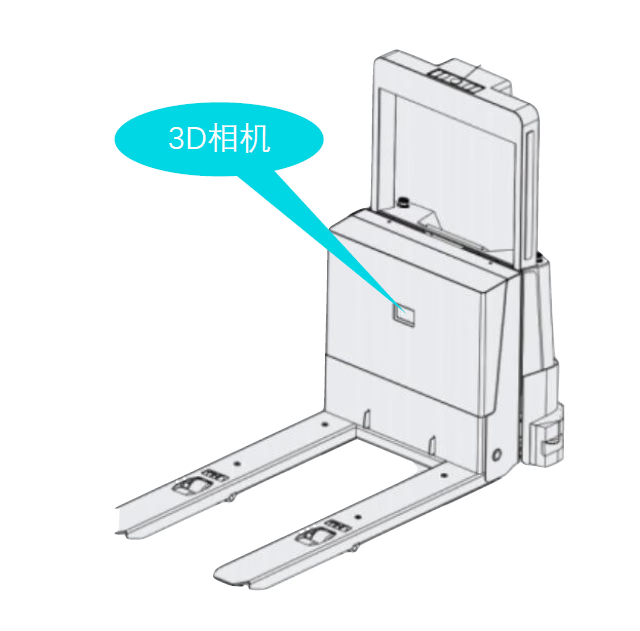
- Deployment and docking: The camera can be installed between the forklift forks. Automatic calibration establishes the coordinate relationship between the camera, vehicle, and pallet. Standard two-leg and four-leg pallets and stacked pallets can be evaluated for the site; legless or unusual pallets require project assessment.
- Integration: The system provides real-time recognition results. Configure the interface, vehicle installation, and docking strategy according to the project documentation.
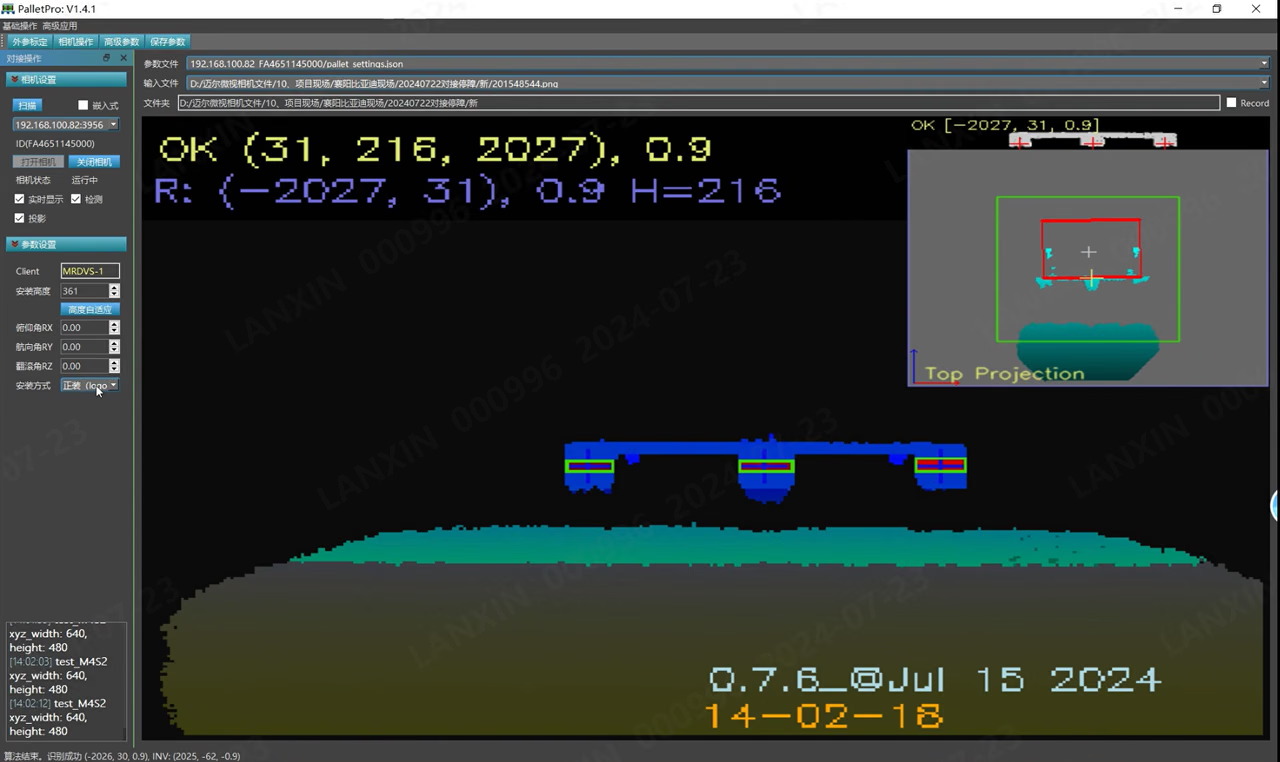
- Environmental adaptation: For strong ambient light or low-reflectivity pallets, validate the camera model, mounting distance, exposure, and filter parameters on site.
Recognition and docking
An M Series camera can be installed between the forklift forks to capture pallet depth data and output pallet pose through the recognition algorithm. In a typical workflow, the vehicle first captures the pose at approximately2 m from the pallet and corrects its heading. It then performs precise positioning and lateral correction at approximately 1.5 m. Validate the actual distances and control strategy for the vehicle, speed, and site.
Two-stage docking
- Remote positioning: Capture recognition results
1,800–2,800 mmfrom the pallet and correct the heading and lateral offset. - Near-field verification: When the fork tips are approximately
200 mmfrom the pallet front edge, capture the result again and check whether it meets the forking requirements. - Forking: Fork the pallet after verification. If verification fails, adjust the vehicle and verify again.
Real-time docking
Continuously capture recognition results to adjust the vehicle pose. Make fine corrections and complete forking at approximately200 mm from the pallet front edge. The control system should use data timestamps to handle latency.
Communication
The solution supports interfaces such as TCP, UDP, CAN, RS-485, and API. Check the relevant product and deployment documentation for availability and message formats. Switch between recognition and obstacle-avoidance algorithms according to the project configuration.Case studies
Case 1: Pallet and cable-drum-hole recognition for an optical-fiber communications company
Project background: Company F uses unmanned stackers for logistics tasks. The project covers recognition and handling of pallets and cable-drum holes. Solution: PalletPro supplies pallet depth and pose information so the vehicle controller can adjust the stacker pose. 3D vision also recognizes cable-drum holes.Case 2: Non-standard pallet recognition in the fiberglass industry