
Scene challenges
- Foliage occlusion: Leaves and branches can hide part of a fruit, making it difficult for conventional segmentation to recover the complete contour.
- Point-cloud quality: Blurred edges, noise, or low point density reduce the usable 3D shape of the target.
- On-device processing: Harvesting tasks need perception and algorithm processing close to the robot to reduce dependence on remote compute.
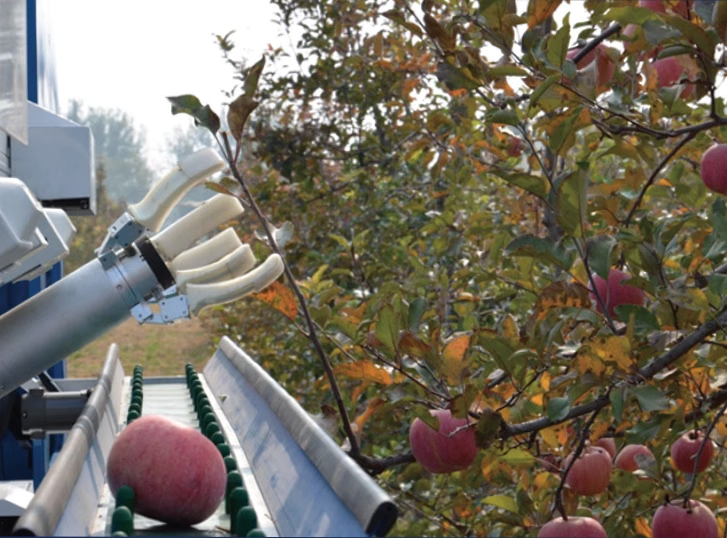
Vision challenges in an orchard
Solution components
Occlusion-aware semantic segmentation
The Intelligent Equipment Technology Research Center of the Beijing Academy of Agricultural and Forestry Sciences uses multi-scale feature fusion and contextual information to help recover apple contours that are partially hidden by foliage.RGB-D 3D perception
The M4 Pro provides RGB images and point-cloud data to capture fruit shape and texture for recognition and harvesting-path planning.On-device algorithm processing
The M4 Pro supports running algorithms on an embedded platform, allowing data processing at the orchard and enabling the robot to respond within the harvesting workflow.Application example
The Intelligent Equipment Technology Research Center of the Beijing Academy of Agricultural and Forestry Sciences developed an integrated multi-arm robot for harvesting, collection, and transport. In a standard dwarf, high-density orchard in Changping, the robot used an MRDVS M4 Pro RGB-D camera to support apple recognition, localization, and harvesting.Actual recognition performance depends on the fruit variety, occlusion, lighting, camera installation, and algorithm configuration. Collect data and validate the system in the target orchard before deployment.