
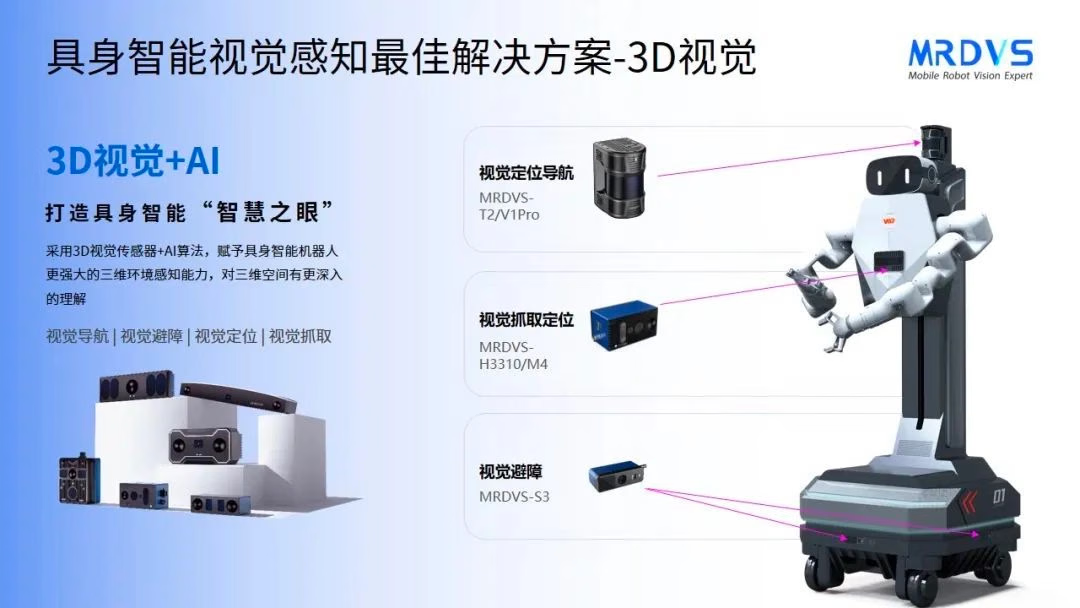
Visual SLAM navigation
The robot uses a T Series visual SLAM camera for mapping and localization during path planning and navigation.- Mapping and localization: Capture environmental features during operation to build a map and estimate the robot pose.
- Dynamic-scene adaptation: Provide environmental data for path planning as people, equipment, and aisles change.
- Long-range perception: The original project material lists a
30 msensing range. Confirm the usable range based on installation, scene features, and on-site validation.
RGB-D obstacle perception
In workspaces shared with people and equipment, the robot uses an S Series RGB-D sensor to capture 3D environmental and texture data.- Obstacle recognition: Use depth and RGB data to detect obstacle position, category, and attributes.
- Avoidance inputs: Feed perception results to higher-level policies for detouring, slowing, or stopping.
- Multi-robot deployment: Validate camera placement, overlapping fields of view, and on-site interference.
3D grasp perception
The robot uses an H Series structured-light camera to capture point clouds for object-shape and pose estimation during grasping.- 3D localization: Estimate the position and pose required for grasping.
- Complex objects: Support 3D perception of irregular or stacked objects.
- Lighting conditions: Actual performance depends on material, surface reflectivity, ambient light, and camera installation.
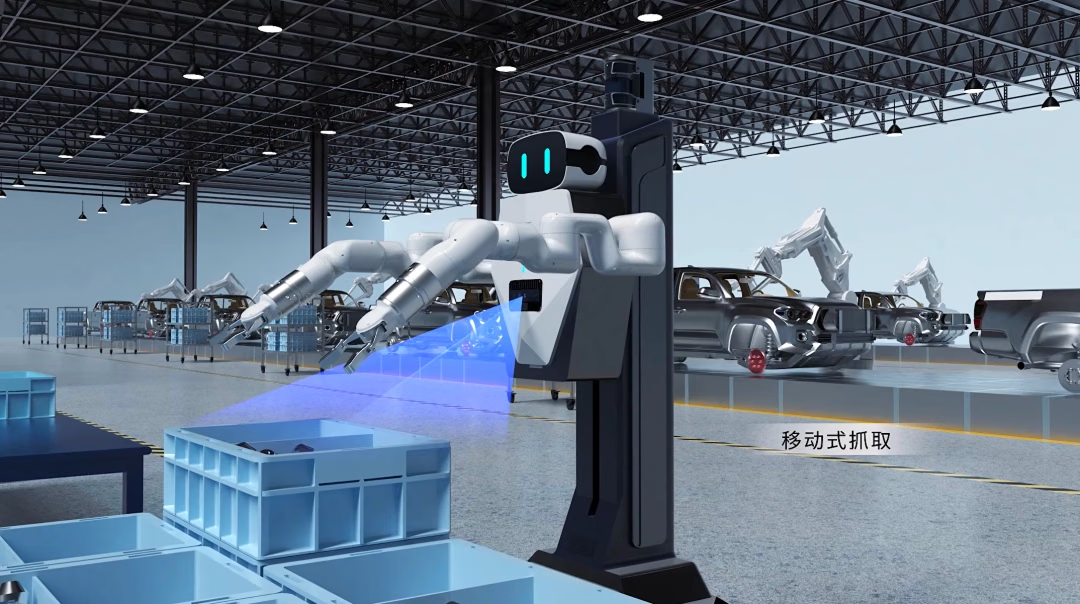
This page describes the perception roles in the case. Motion control, task planning, functional safety, and system-level acceptance of the complete robot are handled by the robot platform.